
Article
"More overhauls prevent failures": what the original RCM study actually said
Does overhauling more often prevent failures? What Nowlan and Heap's 1978 Reliability-Centered Maintenance report found in United Airlines data: six failure patterns, only 4% bathtub, 89% with no wearout zone, and when an overhaul actually pays. With page references and limits.
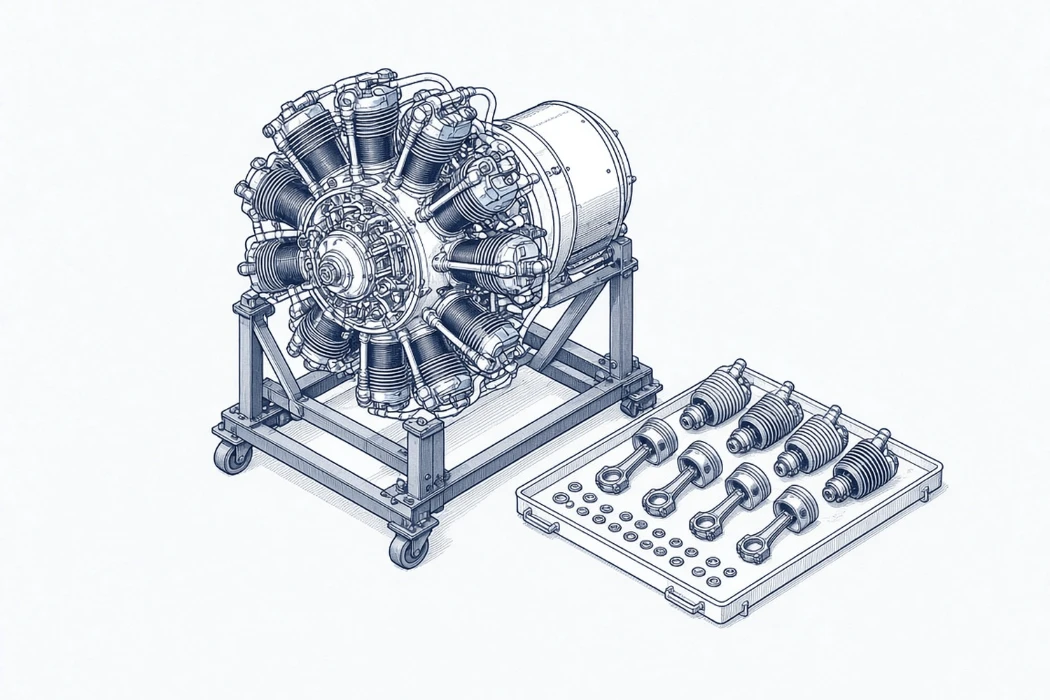
In the spring of 1959, United Airlines had to decide whether to let two piston engines run longer between overhauls. An inspection team tore down Pratt & Whitney R-2800 engines that had reached the 1,800-hour limit and judged many parts to be in poor enough condition that the engines could not have reached the proposed new limit without failures. The failure data said otherwise. The limit was extended anyway, and the R-2800's overhaul time was eventually pushed to 3,300 hours, "with substantial economic benefits, despite adverse inspection reports at each step." The authors of the 1978 study that defined reliability-centered maintenance call that clash between skilled inspectors and the failure records a paradox (pp. 374-375).
The belief that inspectors and planners kept running into is still common in maintenance planning: if a machine fails, overhaul it more often. The 1978 report by F. Stanley Nowlan and Howard F. Heap was written after airline data had already shown that this belief was failing in practice. This post sets out what that report actually says, with page references, and where its evidence stops.
Short answer: Reliability-centered maintenance (RCM), as Nowlan and Heap defined it in 1978, is a scheduled-maintenance program designed to realize the inherent reliability of equipment. Its starting point was evidence, not a theory: United Airlines found that for most items failure did not become more likely with age, so a fixed overhaul age did little or nothing.
Applies to: Maintenance managers and plant heads who set preventive-maintenance and overhaul intervals. The report's data come from US commercial aircraft between the late 1950s and the 1970s; the authors say the principles extend to other complex equipment, with caveats covered below. Last verified: 23 Nov 2026. Author: Muhammed Fahiz
What is reliability centered maintenance?
The report opens with its own definition. The term reliability-centered maintenance "refers to a scheduled-maintenance program designed to realize the inherent reliability capabilities of equipment" (p. 2).
"Inherent reliability" is doing a lot of work in that sentence. The authors define it as the level of reliability achieved with an effective maintenance program, set by the design of each item and the manufacturing processes that produced it. Scheduled maintenance can make sure that level is achieved, but in their words no form of maintenance can give reliability beyond what is inherent in the design (pp. xvii-xviii). If the reliability that results is not good enough, "the only recourse is engineering redesign" (p. 9).
The report itself is a book-length document from United Airlines, dated December 1978 and distributed by the US National Technical Information Service as report AD-A066579. Its DTIC record (via Crossref) dates it 29 December 1978 and lists a US Department of Defense office, OASD(MRA&L), as the funder. Its stated aim is a logical discipline for deciding which scheduled tasks, if any, an item should get and how often.
Where did the "more overhauls" belief come from?
Nowlan and Heap describe the belief directly. Maintenance theory assumed a cause-and-effect link between scheduled maintenance and operating reliability, based on the intuitive idea that mechanical parts wear out, so reliability must depend on operating age. "It therefore followed that the more frequently equipment was overhauled, the better protected it was against the likelihood of failure. The only problem was in determining what age limit was necessary to assure reliable operation" (p. 2).
In aviation that belief was written into the rules. The report's history appendix notes that the initial maintenance program for the Douglas DC-8, authorized in 1959, set hard-time overhauls for 339 items, in addition to scheduled overhauls for the engine and the airplane as a whole (p. 372). Because nobody could predict the "right" overhaul time for a new type, intervals started low and were raised cautiously, often in small steps, each step justified by tearing down a sample of units that had reached the current limit (pp. 372-373).
Two things broke that approach, according to the report:
- Costs. By the late 1950s airline maintenance costs had grown to a level that "warranted a new look at the entire concept of preventive maintenance" (p. 2).
- Data. Studies of actual operating data had begun to contradict the basic assumptions. Actuarial studies suggested that hard-time policies were, apart from their expense, ineffective in controlling failure rates. The authors are specific about why: not because intervals were too long or teardowns too shallow, but because "for many items the likelihood of failure did not in fact increase with increasing operating age" (p. 3).
The FAA was frustrated by the same problem: it had found that airlines could not control the failure rate of certain engine types by any feasible change in overhaul policy. A joint FAA and airline task force formed in 1960, and the FAA/Industry Reliability Program it produced in November 1961 stated that "reliability and overhaul time control are not necessarily directly associated topics" (pp. 3-4, 376-377).
What did United Airlines' failure data show?
This is the most quoted part of the report, and the part most often quoted loosely. While overhaul times were being extended, United Airlines built conditional-probability curves for aircraft components to make sure the longer intervals were not reducing reliability. The curves fell into six basic patterns, shown as Exhibit 2.13 (pp. 45-46). The percentages are the share of the items United studied that fell into each pattern.
| Pattern | Shape of the conditional probability of failure (as the report describes it) | Share of items studied | Report's comment on an age limit |
|---|---|---|---|
| A | Bathtub: infant mortality, then constant or gradually rising, then a pronounced wearout region | 4% | May be desirable, provided a large number of units survive to the wearout age |
| B | Constant or gradually rising, then a pronounced wearout region | 2% | May be desirable (characteristic of aircraft reciprocating engines) |
| C | Gradually rising, with no identifiable wearout age | 5% | Usually not desirable (characteristic of aircraft turbine engines) |
| D | Low when new or just out of the shop, then a quick rise to a constant level | 7% | Grouped with the 89% that cannot benefit |
| E | Constant at all ages | 14% | Grouped with the 89% that cannot benefit |
| F | Infant mortality, then constant or very slowly rising (particularly electronic equipment) | 68% | Grouped with the 89% that cannot benefit |
Source: Nowlan and Heap (1978), Exhibit 2.13, p. 46, with the discussion on p. 47. The exhibit groups A, B and C as the 11% that "might benefit from a limit on operating age" and D, E and F as the 89% that cannot.
The text spells out what the numbers mean. "Some 89 percent of the items analyzed had no wearout zone; therefore their performance could not be improved by the imposition of an age limit." Another 5% (curve C) had no well-defined wearout zone but became steadily more likely to fail with age; for a very few of these an age limit might be useful if it was cost-effective. "Only 6 percent of the items studied showed pronounced wearout characteristics (curves A and B)." And on the curve every maintenance textbook draws: "Although it is often assumed that the bathtub curve is representative of most items, note that just 4 percent of the items fell into this pattern (curve A)" (p. 47).
The items that did show wearout tended to be single-celled or simple items. For aircraft the report lists tires, reciprocating-engine cylinders, brake pads, turbine-engine compressor blades and all parts of the airplane structure (p. 47). Most complex items had curves C to F, with no concentration of failures tied to operating age (p. 47).
Why can an overhaul make things worse?
Two of the six patterns, A and F, start with infant mortality: a period of higher failure probability right after the item is new or back from the shop. Pattern F alone covered 68% of the items studied. The report's horizontal axis is "operating age since manufacture, overhaul, or repair" (p. 46), so every overhaul puts the item back at the start of its curve.
For complex items, the report's conclusion is blunt: "unless there is a dominant failure mode, an age limit does little or nothing to improve the overall reliability of a complex item. In fact, in many cases scheduled overhaul actually increases the overall failure rate by introducing a high infant-mortality rate in an otherwise stable system" (p. 48).
The history appendix records a test of this. In the early 1960s United tried "conditional overhaul" on several items: fix the immediate cause of failure, do whatever else was needed to meet the functional performance specification, and inspect or rework known points of wear, instead of a complete disassembly and remanufacture. Units that got conditional overhauls were monitored and compared with units that got traditional complete overhauls. "The only notable difference was that the units that had received conditional overhauls showed less infant mortality." By 1965 most items subject to overhaul limits were receiving conditional overhauls, with a marked reduction in shop costs and no adverse effect on reliability (p. 383).
When does a scheduled overhaul make sense?
The report does not say overhauls never work. It says they only work under specific conditions, and that the intuition that an age-limit task is always applicable is wrong: "imposing an age limit on an item does not in itself guarantee that its failure rate will be reduced" (p. 51).
A scheduled rework (overhaul) task is applicable only if all three of these are true (p. 57):
- There is an identifiable age at which the item shows a rapid increase in the conditional probability of failure.
- A large proportion of the units survive to that age.
- Reworking the item restores its original failure resistance.
Even then it has to be effective. For failures with safety consequences, fewer expected failures is not enough. For economic consequences, the task has to pay for itself, and "since an age limit lowers the average realized age of an item, it always increases the total number of units sent to the shop for rework" (p. 57).
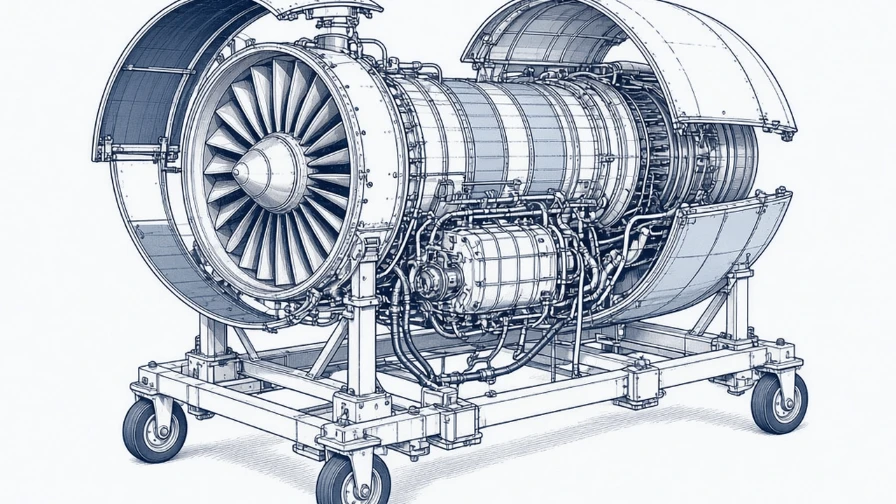
The report works this through for an aircraft turbine engine, the Pratt & Whitney JT8D-7 on the Boeing 737, whose survival curve is based on 58,432 operating hours from May to July 1974 (Exhibit 2.9, p. 41). Exhibit 3.3 (p. 58) compares rework age limits:
| Rework age limit (hours) | Failure rate (per 1,000 hours) | Units surviving to the limit | Average realized engine age (hours) |
|---|---|---|---|
| 1,000 | 0.3681 | 69.2% | 838 |
| 2,000 | 0.4163 | 42.0% | 1,393 |
| 3,000 | 0.4871 | 17.9% | 1,685 |
| None | 0.5522 | 0 | 1,811 |
Over one million operating hours with no age limit, about 552 failed engines go to the shop. With a 2,000-hour limit, about 416 fail, but another 301.6 come in as scheduled removals, for about 718 shop visits in total: "about 135 fewer failures, but 166 more engines that required rework." The authors conclude that rework at 2,000 hours would not be cost-effective unless rework of a scheduled removal cost less than 45.1% of repairing a failure, though failures with operational consequences can change that sum (pp. 57-58). In general, they write, a rework task will not prove cost-effective unless the item has an unusually expensive failure mode or the cost of a functional failure includes losses beyond the direct cost of repair (p. 58).
What replaced the hard-time overhaul?
The report's answer is a small set of task types, chosen item by item according to failure consequences. There are four basic tasks (pp. xviii, 50):
- On-condition inspection of an item at regular intervals to find potential failures.
- Scheduled rework of an item at or before a specified age limit.
- Scheduled discard of an item or one of its parts at or before a specified life limit.
- Failure-finding inspection of a hidden-function item, to find failures that have already happened but were not evident to the operating crew.
On-condition tasks get the most attention. They let each unit stay in service until a defined potential failure is found, so units realize most of their useful lives (p. 51). They are applicable only if reduced failure resistance can be detected for a specific failure mode, a potential-failure condition can be defined and detected by an explicit task, and there is a reasonably consistent interval between potential failure and functional failure (p. 52). In the report's list of facts an organization must accept before adopting RCM: "On-condition inspections, which make it possible to preempt functional failures by potential failures, are the most effective tool of scheduled maintenance" (p. 348).
Which task an item gets, if any, depends on what its failure does. The report sorts failure consequences into four categories: safety, operational (indirect economic loss plus the direct cost of repair), nonoperational (only the direct cost of repair), and hidden-failure consequences, meaning exposure to a possible multiple failure (p. xvi). Scheduled maintenance is required for items whose failure could have safety consequences and for items whose failure would not be evident to the operating crew. "In all other cases the consequences of failure are economic," and tasks must be justified on economic grounds (p. xvii). Some failures are cheaper to correct as they occur than to prevent (p. 7).
The airline results the report gives for this approach:
- The DC-8's initial program under traditional policies scheduled overhaul for 339 items; the DC-10's initial program, built with the MSG-2 decision logic, assigned seven items to overhaul. The turbine engine was one of the items with no overhaul limit in the later program, and dropping that task cut the spare-engine inventory needed to cover shop activity by more than 50 percent (p. 5).
- On the Boeing 747's initial program, United needed 66,000 manhours of major structural inspections to reach a 20,000-hour inspection interval. Traditional policies on the smaller DC-8 took over 4 million manhours to reach the same interval. The authors say these savings came "with no decrease in the reliability of the equipment" (p. 6).
- By 1969 United's Reliability Controlled Overhaul Program covered 277 items with no overhaul time limits at all. An item qualified if actuarial analysis showed its conditional probability of failure did not rise with time since the last shop visit (curves D, E or F). The program required an alert failure rate and an investigation when it was exceeded; most excursions turned out to be sampling effects (p. 382).
These are the report's own figures for United Airlines and the airline programs it describes. They are not results for any other industry.
What is the purpose of RCM?
The report states four objectives for an operator's maintenance program (p. xvi), repeated in its closing chapter for any RCM-based program (p. 347):
- Realize the inherent safety and reliability levels of the equipment.
- Restore safety and reliability to those levels when deterioration has occurred.
- Get the information needed for design improvement of items whose inherent reliability proves inadequate.
- Do all of that at minimum total cost, including maintenance costs and the costs of residual failures.
The third objective is easy to miss. The report treats a maintenance program as a source of information as much as a list of tasks. Any program set before equipment enters service is based on limited information, so the operating organization "must be prepared to collect and respond to real data throughout the operating life of the equipment" (p. xix). The report calls the systematic gathering of that data age exploration (p. 8).
Is there an RCM "golden rule"?
People search for one, but the 1978 report does not use the phrase "golden rule" (we searched the full recognized text). The closest thing to a single governing principle in it is this sentence: "In short, the driving element in all maintenance decisions is not the failure of a given item, but the consequences of that failure for the equipment as a whole" (p. 7).
The report's closing list of facts also includes the line that answers the myth in this post's title: "There is no "right time" for scheduled overhauls that will solve reliability problems in complex equipment" (p. 348).
What does this mean for a plant maintenance manager?
The report addresses equipment beyond aircraft in its final chapter. It names rapid-transit systems, fleets of ships and buses, and machinery used in complex manufacturing processes (p. 347). It also warns that most such equipment is not designed to aircraft standards: less redundancy, so one of many minor failures can stop the equipment; less instrumentation, so more items have hidden failures; and parts that need inspection are often hard to reach or not designed for detecting potential failures. "Under these circumstances RCM analysis will not produce a magic solution to all reliability problems" (p. 347). The authors say it will still identify the tasks and product improvements that would help.
So the honest reading for a plant is not "stop overhauling." It is that the case for any overhaul interval has to be made from evidence about that item. Taking the report's own criteria, these are the questions it would have you answer before shortening an interval after a failure (our checklist, built from pp. 7, 51-52 and 57):
- What were the consequences of the failure: safety, lost production, only the repair cost, or a hidden function that had already failed?
- Do your records show failures concentrating at an age, or spread across ages? The report's evidence for the six patterns came from actuarial analysis of failure data, not from teardown opinion (pp. 45, 374-375).
- Do enough units survive to the proposed age for a limit to change the failure rate?
- Does the overhaul actually restore failure resistance, or does it reset the item into its early-failure period?
- Is there a detectable warning condition, with a consistent interval before failure, that an on-condition check could catch instead?
Every one of those questions depends on records: what failed, at what age, what was found, and what was done. If the same fault is logged five different ways, no age pattern will show up; our post Same machine, five descriptions: why repeat faults never add up covers that record problem. A repair log that stays searchable is where the failure ages come from. For the downtime arithmetic, see MTTR, MTBF and downtime cost: the formulas, with a worked example. For what a 2023 review found about predictive maintenance in one sector, see From corrective to predictive maintenance: what a 2023 power-industry review actually covers.
What this doesn't tell you
- The data are airline data from decades ago. The six patterns and their percentages describe the items United Airlines analyzed over a number of years (p. 46). They are not a measured distribution for pumps, gearboxes or motors in your plant, and the report does not claim they are.
- The percentages are of items studied, not of failures. "89 percent" is the share of analyzed items whose curves fell in D, E or F (pp. 46-47), not the share of all failures.
- Some items do wear out. The report is clear that simple items, and parts subject to metal fatigue or mechanical wear, often show a direct relationship between age and reliability, and that age or cycle limits can be highly effective for them, including safe-life limits for critical failures (pp. xviii, 48).
- It is not a step-by-step method for your site. The decision diagram is described in full in Chapter 4 of the report; this post does not reproduce it. Later RCM standards and guides (for example, NASA's 2008 facilities guide) are separate documents and are not quoted here.
- What we read. The copy we used is a scanned reproduction of the NTIS report, in three PDF parts hosted by Chemical Processing; we ran text recognition on it. We read the front matter, Chapter 1, Section 2.8, Sections 3.1 and 3.2, Section 12.5 and Appendix B sections B-1 to B-4, and searched the rest. Every quotation here was checked against the text, and key exhibits against the page images.
- Search volume for "what is reliability centered maintenance" is unverified.
Where does HangerSearch fit?
The R-2800 story is a reminder that opinion and records can disagree, and that the records won. The questions above can only be answered if what was found on each machine, at what age and after which job, was written down and can be found again.
HangerSearch searches your team's finalized service reports where they already sit and cites the page each answer comes from. It does not set maintenance intervals or run an RCM analysis. See how we handle your reports.
Book a 20-minute demo: hangersearch.com
FAQ
What is reliability centered maintenance? In Nowlan and Heap's 1978 definition, it is "a scheduled-maintenance program designed to realize the inherent reliability capabilities of equipment" (p. 2). In practice that means choosing, item by item, only the scheduled tasks that are both applicable to how the item fails and effective against the consequences of its failure (p. xviii).
What is the purpose of RCM? The report lists four objectives: realize the equipment's inherent safety and reliability; restore them when deterioration occurs; obtain the information needed to improve the design of items whose inherent reliability is inadequate; and do all of this at minimum total cost, including the cost of residual failures (p. xvi).
What is the reliability centered maintenance golden rule? The 1978 report does not use the phrase. Its closest single principle is that "the driving element in all maintenance decisions is not the failure of a given item, but the consequences of that failure for the equipment as a whole" (p. 7).
Do more frequent overhauls prevent failures? For most items in United Airlines' data, no. Some 89 percent of the items analyzed had no wearout zone, so an age limit could not improve them, and for complex items scheduled overhaul can raise the failure rate by adding infant mortality (pp. 47-48). Overhaul can help simple items with a clear wearout age that most units survive to (p. 57).
What are the six failure patterns in RCM? The report's Exhibit 2.13 shows six conditional-probability patterns, A to F: bathtub (4%), wearout at the end (2%), gradually rising (5%), low then quickly constant (7%), constant (14%), and infant mortality then constant (68%), as shares of the items United studied (p. 46).
Who wrote the original RCM report? F. Stanley Nowlan, Director of Maintenance Analysis, and Howard F. Heap, Manager of Maintenance Program Planning, both at United Airlines. It was published in December 1978 and is NTIS/DTIC report AD-A066579.
Sources
- Nowlan, F. Stanley and Heap, Howard F. Reliability-Centered Maintenance. United Airlines, San Francisco, December 1978. Funded by OASD(MRA&L), US Department of Defense, per the DTIC record as shown in Crossref metadata. NTIS/DTIC report AD-A066579, dated 29 December 1978, DOI https://doi.org/10.21236/ADA066579. Copy used: scanned NTIS reproduction in three parts, hosted at https://www.chemicalprocessing.com/reliability-centered-maintenance (downloaded 23 Nov 2026, 520 PDF pages; text recognized on the box). Page numbers in this post are the report's printed page numbers (roman numerals for the front matter). Supports: the definition and objectives; the precepts; the history of hard-time policies, the DC-8 program and the R-2800 paradox; the FAA/Industry Reliability Program quote; the six age-reliability patterns and percentages; the infant-mortality point; conditional overhaul; the four basic tasks and their applicability criteria; the JT8D-7 rework example; the DC-10, 747 and RCOH figures; and the caveats for non-aircraft equipment.
Related
- From corrective to predictive maintenance: what a 2023 power-industry review actually covers
- Same machine, five descriptions: why repeat faults never add up
- MTTR, MTBF and downtime cost: the formulas, with a worked example in INR and USD
- Equipment repair log template that stays searchable
- How HangerSearch handles your data