
Article
From corrective to predictive maintenance: what a 2023 power-industry review actually covers
What is predictive maintenance? A plain-language explainer of Moleda et al. (2023), a Sensors review of power-industry maintenance: corrective vs preventive vs predictive, the techniques on the machines, what each analytics method needs, and why plants still rely on older strategies.
The instruction to "move to predictive maintenance" can arrive as one line on a strategy slide. On the machines, the work that follows has to be something specific: a vibration route on the boiler feed pumps, an oil sample from a turbine bearing, a thermal camera pointed at a switchboard, or a data model trained on control-system history. The slide and the job list use the same word for very different things, and it is not always clear which one was meant.
A 2023 open-access review in the journal Sensors, by Marek Moleda, Bozena Malysiak-Mrozek, Weiping Ding, Vaidy Sunderam and Dariusz Mrozek, is a useful reference for closing that gap. It sets out what corrective, preventive and predictive maintenance mean, lists the measurement techniques that sit under "predictive", sorts the analytics methods by what they need, and then says plainly why power plants still lean on the older strategies. This post explains what the paper covers, where its numbers come from, and what it does not tell you.
Short answer: Predictive maintenance is servicing carried out when it is required, usually shortly before a fault is expected, based on predicting a machine's health from repeated analysis or known characteristics. Moleda et al. (2023) call it a type of condition-based maintenance and contrast it with corrective maintenance (after a failure) and preventive maintenance (scheduled inspections and replacements).
Applies to: Reliability and condition-based maintenance (CBM) specialists, and the engineers who have to turn a "predictive maintenance" target into work on real equipment. The paper's focus is the power-generation sector (thermal, gas, wind, solar and hydro); the authors say some of the issues are common to other industries. Last verified: 21 Nov 2026. Author: Muhammed Fahiz
What is predictive maintenance?
In this review, predictive maintenance means the servicing is carried out "when it is required, usually shortly before a fault is expected." The authors describe the essence as predicting the health of a machine "based on repeated analysis or known characteristics," and they place it inside a larger family: "predictive maintenance is a type of condition-based maintenance in which we predict future performance based on current and historical indicators" (Section 2.3, p. 7).
They also say what it is meant to change. In their words, it "leads to a reduction in both planned and unplanned downtime": planned downtime because preventive actions can be better scheduled, and unplanned downtime because some unexpected failures can be avoided by monitoring the equipment condition continuously (p. 7).
The paper starts one level higher, with maintenance itself. It quotes the European standard EN 13306 definition: maintenance is a combination of all technical, administrative and managerial actions during the life cycle of an item intended to retain it in, or restore it to, a state in which it can perform the required function. It then lists what that covers: inspections, condition monitoring, routine maintenance, replacement of parts, repairs, overhauls, and the planning and supervision of all of these (Section 2, pp. 5-6).
What is the difference between predictive and preventive maintenance?
The paper sorts maintenance strategies by one question: when is the repair done, relative to the failure? That gives three basic approaches: corrective, preventive and predictive (Section 2, p. 6, Figure 3).
| Corrective | Preventive | Predictive | |
|---|---|---|---|
| When the work is done | After a failure has occurred | On a schedule of periodic inspections and replacements | When it is required, usually shortly before a fault is expected |
| What sets the timing | The failure | Manufacturer recommendations, or quality parameters such as MTBF and MTTF | The predicted health of the machine, from current and historical indicators |
| What the paper says it is suited to, or good at | Non-critical, easily repairable equipment | Keeping equipment in good condition and reducing the risk of downtime | Reducing both planned and unplanned downtime |
| What the paper says it costs or misses | Higher risk of the equipment being unavailable; lost revenue, more damage to related equipment, longer and costlier unplanned repairs | Does not protect against unexpected failures or defects in parts the plan does not cover; replacing parts too often has its own risks | Extra measurement equipment, data and expertise (see the techniques and methods below) |
| Source in the paper | Section 2.1, p. 6 | Section 2.2, pp. 6-7 | Section 2.3, p. 7 |
Two points in the preventive section are easy to miss. First, the authors give two reasons, citing Mobley's An Introduction to Predictive Maintenance, why replacing parts too often is not always good: fitting a replacement can add risk of failure, assembly error, hidden defects or a non-matching part, and new parts and consumables have a higher probability of being defective than materials already in use (p. 7). Second, they say that planning preventive schedules "requires historical data": maintenance history, usage conditions or failure history, or failing that, data for the same or a similar device or from the manufacturer (p. 7). If you calculate intervals from MTBF, the inputs are only as good as the breakdown records behind them; the MTTR and MTBF formulas with a worked example show what goes into each number.
The corrective section has a power-plant detail too. The authors say a more proactive approach is expected for components whose failure can cause downtime, for example a steam boiler or turbine, and for equipment whose failure can damage associated equipment, such as conveyor belts in explosion-hazard areas, evaporators, or high-pressure steam pipelines. They also note that in continuous production some parts "permanently work in a defective state", with slowly worsening efficiency, vibration or heating that has little effect on output, which makes the problem hard to see (p. 6).
Which techniques sit under "predictive" on the actual machines?
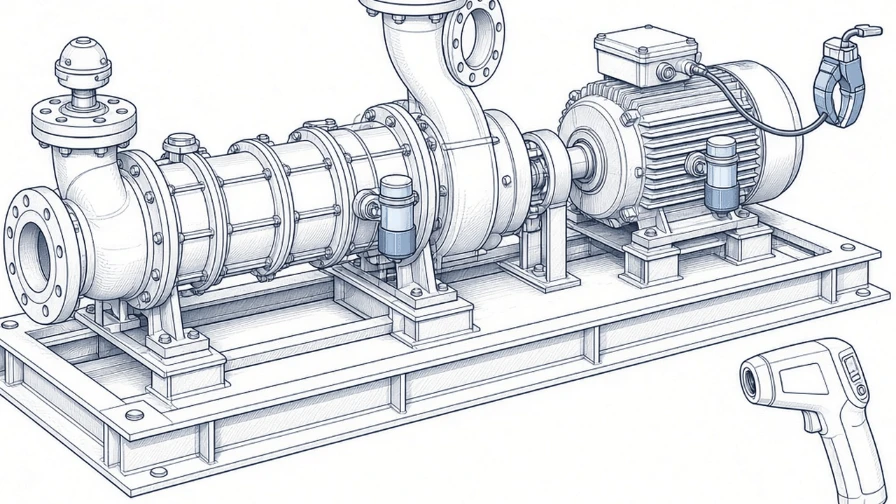
The paper lists the conventional predictive maintenance techniques, which it describes as based on periodic measurements (Sections 2.3.1 to 2.3.7, pp. 7-9). This is the list to hold a strategy slide against.
| Technique | What the paper says it looks at | Limits or conditions the paper states |
|---|---|---|
| Vibration monitoring | All motion and rotating machinery: pumps, fans, compressors, gearboxes, engines, turbines. Trend analysis of vibration levels to estimate remaining useful life and deterioration; signal-profile analysis to detect specific faults | Costly, because it needs additional measurement equipment. Machine-learning methods allow rapid diagnostics without involving experts in the analysis |
| Thermography | Temperature and its distribution, from thermal cameras, infrared thermometers or line scanners. Examples: wall thinning in high-temperature pressure pipe, material loss in boiler water-wall tubing, electrical equipment, oil leaks, photovoltaic farms | No specific limits stated |
| Oil analysis | Viscosity, contamination, solids, oxidation, nitration, acid and base numbers, particle count; spectrography and ferrography for wear particles | Equipment cost, and difficulty in oil sampling and in interpreting results |
| Acoustic and ultrasonic analysis | Noise and ultrasound from rotating machinery; ultrasonic leak detection in valves and pipes; cavitation in centrifugal pumps; can complement vibration on gearboxes | Described as possible "with relatively inexpensive tools" |
| Motor current analysis | Electric motors and other electrical equipment: insulation resistance test, and motor current signature analysis (MCSA) | Covered in the next section |
| Process parameters | Performance or health indicators calculated from plant data, for example pump efficiency from flow, heat and power; or a health index from historical data or a similar machine | Widely combined with IoT, machine learning and big data |
| Visual inspection | Traditional inspection, supported by engineering experience and by tools such as augmented reality, mobile apps, RFID and barcodes | The authors say online monitoring and predictive improvements "sometimes cannot replace traditional inspection methods" |
The last row matters for anyone writing the plan. The paper does not treat predictive maintenance as a replacement for walking the plant. It says maintenance built on models and installed metering "should be supported by engineering experience in the inspection process" (p. 9).
What is predictive maintenance in electrical equipment?
For electrical machines, the review points to two methods in addition to vibration and acoustic monitoring: the insulation resistance test and motor current signature analysis (Section 2.3.5, p. 9). The authors' reason for singling out motors is direct: the electric motor is part of most power plants, and its failures "often lead to energy production outages". They list common motor failures as bearing failures, stator winding faults, rotor faults and insulation faults.
- Insulation resistance test. The paper describes it as grounding the motor frame, applying a DC voltage to the windings with a measuring device, and reading the resistance. It notes that insulation can be damaged by high temperature or contaminated by humidity. The paper gives no test voltages or pass values, and neither does this post.
- Motor current signature analysis (MCSA). The supply current is turned into a frequency spectrum. Faults in motor components disturb the magnetic field and the motor's inductances, and that shows up in the current spectrum. The paper says MCSA is used on induction motors, generators, power transformers and other electrical equipment, and lists the faults it can detect: broken rotor bars, bearing faults, eccentricity (unequal air gap between rotor and stator), stator or armature faults usually linked to insulation failure, and long-term equipment wear.
Elsewhere the paper mentions thermography for "diagnosing electrical equipment" (p. 8) and, in its section on signal-based methods, current frequency analysis and amplitude demodulation used to detect bearing faults in wind turbines, which it says gives "an additional economic advantage in the absence of online vibration monitoring" (Section 4.5.2, p. 22). It also cites fault tree analysis applied to power transformers (Section 3.4, p. 12).
What does the review actually cover beyond definitions?
Most of the 47-page article is about methods, not definitions. The authors list four contributions (Section 1.3, p. 5): it sets traditional maintenance approaches against analytics that extend or automate them; it covers diagnostics, prediction and prescription with applications narrowed to the power industry; it proposes a simplified two-way classification of fault-detection and prognosis methods (model-based or data-driven, qualitative or quantitative); and it discusses the barriers that stop methods proven in theory from being used in production.
In between, it covers:
- Classic reliability methods (Section 3, pp. 9-14): Total Productive Maintenance, Reliability-Centered Maintenance (with its seven questions about functions, failures, causes, effects and consequences), FMEA with the risk priority number, fault tree analysis, and root cause analysis (5 Whys, fishbone, Pareto).
- Four levels of analysis (Section 4.1, pp. 14-15): descriptive ("what happened?", for example calculating MTTF), diagnostic ("why did it happen?": fault detection, isolation and identification), predictive ("what will happen?", including remaining useful life) and prescriptive (simulating decision paths and choosing one).
- Prognostics and health management methods (Sections 4.2-4.7, pp. 15-26): model-based methods such as fault trees, expert systems and analytical redundancy; data-driven methods such as fuzzy systems, trend analysis, PCA, PLS, SVM, Bayesian networks, Markov models and neural networks; signal-based methods in the time, frequency and time-frequency domains; and remaining useful life (RUL) estimation.
- Prescriptive maintenance and digital twins (Section 4.8, pp. 26-29), and other enablers: Industrial IoT, big data, cloud and edge computing, augmented reality, RFID and 3D printing (Section 5, pp. 29-33).
- Summary and challenges for the energy industry (Section 6, pp. 33-35).
How does the review sort the analytics methods by what they need?
The most practical part for a CBM specialist is the summary of what each group of methods requires (Section 4.7, pp. 25-27, Tables 2 and 3). The paper rates methods against four resource requirements: expert knowledge, data science skill, a large historical dataset, and transparency. Its own summary sentences, paraphrased:
- Physical models give the most accurate results, but need considerable modelling effort and extensive domain knowledge.
- Fuzzy systems, particle and Kalman filters and stochastic methods deal well with noise.
- Neural networks and Bayesian networks are used for non-linear relationships in the data.
- Analytical-redundancy (residual) methods and neural networks are best at detecting previously undefined faults.
- Expert knowledge is especially needed for expert systems, physics-of-failure models, fault trees, Markov models and Bayesian networks.
- Both a large dataset and data-science skill are needed for neural networks and stochastic methods, unless there is a representative sample of data.
The trade-offs in Table 3 (p. 27) are worth reading before buying anything. Expert systems are transparent but work only with cases that have been defined. Neural networks can model complex relationships without domain knowledge, but their results may be non-transparent ("black box"), they are prone to overfitting, the uncertainty of their results is hard to determine, and they need a large training set. ARIMA models are computationally cheap but forecast only in the short term and are sensitive to noise.
On remaining useful life, the paper says the main difference from diagnosis is that events are predicted in the future, which needs confidence intervals and an allowance for uncertainty. It lists the properties a usable health index should have (monotonicity, robustness, trendability, identifiability and consistency), and says that calculating RUL requires comprehensive data on the current condition of the device and a classification of its potential failure modes (Section 4.6, pp. 23-24).
Why do power plants still rely on corrective and preventive maintenance?
The review answers this itself. In its summary, the authors write that the energy industry "cautiously benefits from new technologies, applying new solutions in a narrow range," and that "corrective and preventive strategies are still the main approaches used in the energy sector" (Section 6.1, pp. 33-34). They note that complex solutions such as big data and predictive maintenance are usually supplied as part of a control system or as an extra service from the control-system provider, and name GE's Predix and ABB Ability as examples.
Then they ask why methods that work in other industries or in laboratories are not used in the real world, and give these reasons (Sections 6.2 and 6.3, pp. 34-35):
- Long-lived equipment and control systems. Plants run equipment designed to operate for years, so integrating new solutions is a technological barrier if it was not considered at the design stage.
- A business case is required. Investments must show a return.
- Availability is already designed in. High availability has for years been achieved by duplicating critical equipment functions and by keeping spare components such as motors or pumps. The authors say the profit from a smarter approach appears only if it lets the plant cut back traditional preventive actions, which means accepting some risk.
- Attribution is hard. In performance improvement, "it is easy to make a mistake or statistical fallacy"; the authors ask what influence the predictive maintenance system, crew training or an overhaul actually had on the result.
- Users and conditions. Tools for operators should take into account information noise and the stressful nature of their work; planning tools should be integrated with enterprise systems that show financial impact and risk; decision support has to deal with uncertainty, especially when decisions are made under stress and must follow applicable procedures.
- Safety, regulation and cyber security. Power plants are often critical infrastructure. That adds cyber and physical security requirements, may require on-premise rather than cloud computing, and raises the cost of implementation.
- Priorities. The authors write that the power industry is an area "where stability and security are prioritized over the implementation of innovations," and that new solutions should engage engineers from the industry.
For a reliability specialist, this section is the most useful thing to bring to the meeting where the strategy slide is presented. It is not written only from the outside: the first author's listed affiliation is a power-generation company, TAURON Wytwarzanie S.A. in Poland (p. 1); the other four authors are listed at universities in Poland, China and the US.
Where do the "5 to 20 percent" and McKinsey figures come from?
They are not findings of this paper. The introduction opens with two consultant figures, each cited to an outside report (Section 1, p. 1):
- "According to a Delloite report" (the paper's spelling), inappropriate maintenance strategies can reduce overall production capacity by 5 to 20 percent. The paper's reference is a 2017 Deloitte document, Predictive Maintenance and the Smart Factory.
- McKinsey "forecasts" that digital maintenance can increase asset availability by 5 to 15 percent and reduce maintenance costs by 18 to 25 percent. The reference is a 2018 McKinsey article, Digitally Enabled Reliability: Beyond Predictive Maintenance.
The same introduction cites an IoT Analytics market report for predictive maintenance and inspection quality being the top industrial use cases, and a 2018 PwC report for the value drivers (uptime, cost reduction, safety, health, environment and quality, and longer asset life) (pp. 1-2). We have not opened those four reports. If you quote any of these figures, attribute them to the consultancy that published them, not to Moleda et al., and not to power plants specifically: the paper does not say they were measured in the power sector.
What can a reliability specialist do with this paper?
The paper does not give a step-by-step rollout plan. What it does give is a set of distinctions that can be applied to any "predictive maintenance" line in a plan. The questions below are our reading of the paper's own framework, not a procedure from the authors.
- Which strategy is this line really? If the work is a fixed-interval replacement, the paper would call it preventive, however it is labelled. Predictive, in its definition, depends on the machine's predicted health (p. 7).
- Which technique, on which asset? Name the measurement from the paper's list (vibration, thermography, oil, acoustic, motor current, process parameters, visual inspection) and the equipment it applies to (pp. 7-9).
- Which level of analysis is promised? Detecting that something is wrong (diagnostic) is a different claim from estimating remaining useful life (predictive), and different again from recommending an action (prescriptive) (pp. 14-15).
- What does the method need? Expert knowledge, data-science skill, a large historical dataset, transparency (pp. 25-27). If the method needs labelled failure history the plant does not have, that is the first gap to close.
- Where does the history come from? The paper notes that repair, diagnostic and warranty history typically sits in an EAM system or CMMS (Section 3, p. 10), and that plant data includes "human-created records" as well as machine-generated logs (p. 3). In the wind-turbine RCM work it cites, the authors of that study "drew attention to the importance of the standardized and automated collection of failure and maintenance data" (pp. 10-11). An equipment repair log that stays searchable is the unglamorous part of that.
- Does it fix causes, or only predict events? The paper's root cause analysis example is a seized bearing: the corrective approach replaces it, while root cause analysis looks for poor lubrication, oil leakage or vibration so it does not happen again (Section 3.5, p. 13). When the same machine keeps breaking down, the records have to make the repeat visible first.
What this paper doesn't tell you
- It is a narrative review, not a measurement. It reports no new field data, and it does not describe a systematic search method (no databases, search strings or inclusion criteria are stated). Its claim that no other review covers traditional and modern techniques in the energy sector "in such a comprehensive manner" (p. 3) is the authors' own assessment.
- Its scope is power generation. The authors focus on the power-generation sector and say some issues are common to other industries (Abstract). It does not test whether its conclusions hold for discrete manufacturing, process plants or machine builders' service teams.
- The consultant figures are cited, not measured. The Deloitte, McKinsey, IoT Analytics and PwC numbers and claims are from those reports. We have not read them, and the paper does not say they were measured in power plants.
- It does not give thresholds. There are no vibration limits, insulation-resistance pass values, oil-analysis alarm levels or intervals. Use the relevant standards and the OEM's documentation for those.
- It does not compare costs or results across plants. It cites individual studies (for example, a fault-prediction accuracy "around 95%" from an aviation study, p. 12), but those are results of the cited papers, in their own settings. We have not read those studies either.
- Its closing view is a direction, not evidence. The conclusions say classic methods needing specialized equipment and expert analysis "are replaced by" AI inference on existing metering (p. 35). The same paper's Section 6 says corrective and preventive maintenance are still the main approaches in the energy sector. Read the conclusions as the authors' view of where the field is going.
- The vendor platforms are named, not evaluated. GE Predix, ABB Ability and Valmet are mentioned as examples of offerings; the paper does not assess them.
Where does HangerSearch fit?
The paper is clear that predictive methods depend on history: failure history to plan intervals, labelled cases to train models, failure modes classified before remaining useful life can be estimated. Some of that history sits in finalized service, inspection and test reports kept as PDFs, not as structured fields in a database.
HangerSearch indexes those finalized-report PDFs where they already sit. When you describe a fault, it shortlists prior cases, shows why each one matched, and opens the cited page in the original report. If nothing in the archive matches, it says so. It does not predict failures, and it is not a condition-monitoring system. See how we handle your reports.
Book a 20-minute demo: hangersearch.com
FAQ
What is predictive maintenance? In Moleda et al. (2023), predictive maintenance is servicing carried out when it is required, usually shortly before a fault is expected, based on predicting a machine's health from repeated analysis or known characteristics. The authors describe it as a type of condition-based maintenance that predicts future performance from current and historical indicators, and say it reduces both planned and unplanned downtime.
What is the difference between predictive and preventive maintenance? Preventive maintenance follows a schedule of periodic inspections and replacements, set from manufacturer recommendations or quality parameters such as MTBF and MTTF. Predictive maintenance times the work from the machine's predicted health. The review notes that preventive maintenance does not protect against unexpected failures or defects in parts the plan does not cover, and that replacing parts too often carries its own risks.
What is predictive maintenance in electrical equipment? For electric motors, the review lists the insulation resistance test and motor current signature analysis (MCSA), alongside vibration and acoustic monitoring. MCSA reads faults from the supply-current spectrum and, according to the paper, can detect broken rotor bars, bearing faults, eccentricity, stator or armature faults and long-term wear. The paper also mentions thermography for diagnosing electrical equipment.
Is predictive maintenance the same as condition-based maintenance? Not exactly, in this paper's terms. The authors call predictive maintenance "a type of condition-based maintenance": it uses the equipment's condition, and also predicts future performance from current and historical indicators.
Did this paper find that predictive maintenance cuts costs by 18 to 25 percent? No. That range is a McKinsey forecast, cited in the paper's introduction together with McKinsey's 5 to 15 percent availability figure. The "5 to 20 percent" loss of production capacity is cited to a Deloitte report. The paper itself does not measure costs or savings.
Why don't power plants use predictive maintenance everywhere? The review gives several reasons: long-lived equipment and control systems that are hard to integrate, the need for a business case, availability already achieved through redundant equipment and spares, difficulty attributing results, safety, regulatory and cyber-security requirements in critical infrastructure, and an industry that prioritizes stability and security over innovation. It states that corrective and preventive strategies are still the main approaches in the energy sector.
Sources
- Moleda, M., Malysiak-Mrozek, B., Ding, W., Sunderam, V. and Mrozek, D. (2023). "From Corrective to Predictive Maintenance - A Review of Maintenance Approaches for the Power Industry." Sensors 23(13): 5970. Published 27 June 2023, open access (CC BY 4.0). DOI: 10.3390/s23135970. PDF (47 pages) read in full on 21 Nov 2026. Supports: every statement in this post attributed to the paper, with section and page numbers given in the text.
- Consultant and market reports cited by Moleda et al. and quoted here only as the paper cites them (not opened by us): Deloitte, Predictive Maintenance and the Smart Factory (2017), paper reference [1]; McKinsey, Digitally Enabled Reliability: Beyond Predictive Maintenance (2018), reference [2]; IoT Analytics, Industrial AI Market Report 2020-2025 (2019), reference [3]; PwC, Predictive Maintenance 4.0 beyond the Hype: PdM 4.0 Delivers Results (2018), reference [4].