
Article
VFD overcurrent trip: isolating motor, cable, load or drive
An overcurrent trip can come from the drive, the motor cable, the motor or the load. Nine checks that take them off the list one at a time: drive alone, insulation tests with the drive disconnected (never the drive), cable vs motor, settings, uncoupled run. Siemens, ABB and Yaskawa page refs.
Short answer: A VFD overcurrent trip has four suspects: the drive, the motor cable, the motor and the load. Record the trip data before resetting. Power the drive with the motor cable disconnected. Insulation-test the cable and motor with the drive disconnected, never the drive itself. Split cable from motor at the terminal box. Then uncouple the load.
Applies to: three-phase AC drives in general, with worked references for Siemens MICROMASTER 440 (F0001), ABB ACS580 (2310) and Yaskawa A1000 (oC). Other drives use different codes and limits, so check your own manual · Manuals used: Siemens MICROMASTER 440 Operating Instructions 6SE6400-5AC00-0BP0 (Issue 12/01) and Parameter List 6SE6400-5BB00-0BP0 (Issue 01/06); ABB ACS580 Firmware manual 3AXD50000016097 Rev J and ACS580-01 Hardware manual 3AXD50000044794 Rev D; Yaskawa A1000 Technical Manual SIEP C710616 27C · Last verified: 25 Oct 2026
What does it look like when you've ruled out everything but the drive?
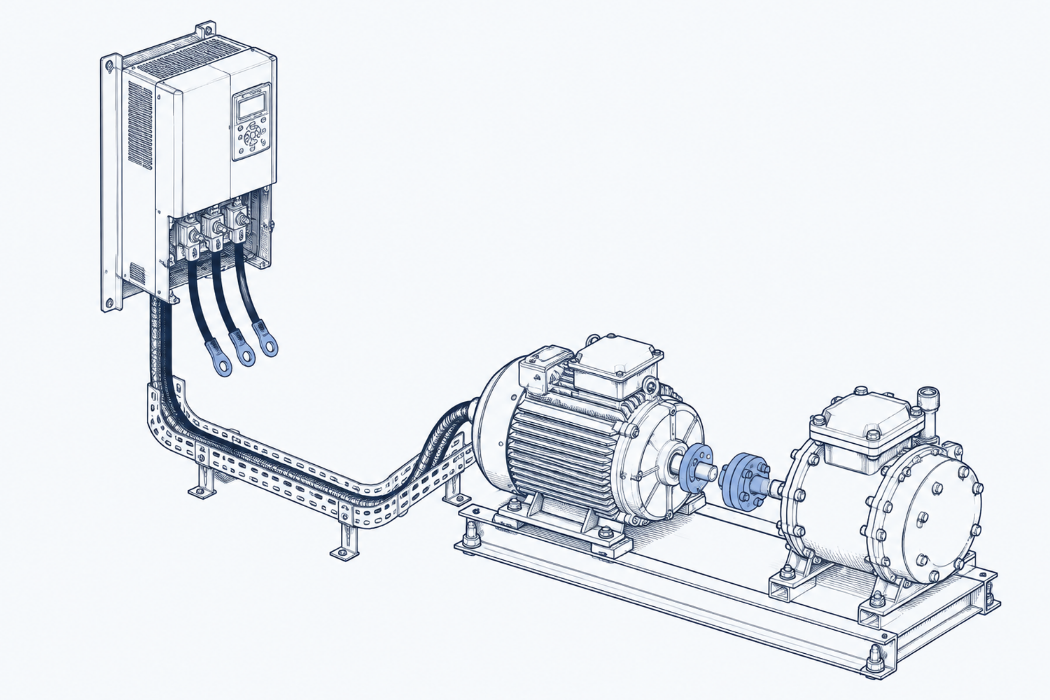
A 45 kW MICROMASTER 440 runs a compressor in a cooled boiler room. The motor is about 20% smaller than the drive's rating, and the load has what the owner calls "strong torque variations". One day the drive trips on F0001 and won't reset.
The owner, JS1892, posted on the Siemens support forum in September 2021, and the order of his checks is the point of this post. He disconnected the motor and still couldn't reset the fault. He insulation-tested the motor with it disconnected: every phase to earth read above 200 MΩ. Phase to phase read close to 0 Ω, which he put down to the star-wired windings. He couldn't split the windings to test them separately, because the motor leads went straight into the motor with no terminal box. Then he took the drive to the workshop and powered it up with all the controls disconnected. F0001 was still there and still wouldn't reset, "therefore there must be an issue with the drive".
He also asked: "Is there no chance at all to get Siemens manuals?" Another member, wmartin987, asked about runtime, ambient and load, said he knew of no MM4 test procedure, and noted that the drive could still be ordered as a spare or replaced with a G120 retrofit kit. No fix was posted.
He did the job well. Each test took one suspect off the list, and the last one standing was the drive. Most overcurrent trips can be worked the same way.
Why does one overcurrent code have four suspects?
Because the drive only sees current. It can't tell whether the extra current came from its own output stage, a cable fault, a damaged winding or a jammed machine. The manuals of all three makers say this in their cause lists:
- Siemens MM440, F0001 OverCurrent: motor power not matching inverter power, a short circuit in the motor leads, earth faults. The checks run from motor data and cable length to the cable and motor, stator resistance, an obstructed or overloaded motor, ramp time and boost (Operating Instructions p. 82). If an output phase shorts to ground on an ungrounded supply, the MM440 trips on F0001 (p. 26).
- ABB ACS580, 2310 Overcurrent: output current above the internal fault limit. ABB adds that an earth fault or a supply phase loss can also cause it. The checks cover motor load, acceleration times, the motor and cable (including phasing and star/delta), contactors switching in the motor cable, start-up data against the rating plate, power factor correction capacitors or surge absorbers in the motor cable, and the insulation of the motor and cable (Firmware manual p. 554).
- Yaskawa A1000, oC Overcurrent: the causes run from a motor damaged by overheating or with damaged insulation, a shorted or grounded motor cable and too heavy a load, through acceleration and deceleration times, V/f settings, torque compensation and an output contactor switching while the drive is running, to starting into a coasting motor and a drive rated too small (Technical Manual p. 311).
None of these lists is a test order. On site, some tests rule out more than one suspect at once, so it's worth doing those first.
Which test rules out which suspect?
| Test | Drive | Motor cable | Motor | Load | Source |
|---|---|---|---|---|---|
| Trip data read before reset | Narrows it | Narrows it | Narrows it | Narrows it | ABB FW pp. 538–539; Yaskawa TM p. 334 |
| Drive powered with motor cable disconnected | Tested | Out of circuit | Out of circuit | Out of circuit | MM440 Parameter List p. 309 |
| Insulation test of cable + motor, phase to PE, drive disconnected | Not tested (never test the drive) | Tested | Tested | No | ABB HW p. 114; MM440 OPI p. 26 |
| Same test split at the motor terminal box | No | Tested alone | Tested alone | No | Our method; see the field report below |
| Settings checked against rating plate and ramps | Settings only | No | Motor data | Ramp vs inertia | ABB FW p. 554; Yaskawa TM p. 311 |
| Motor run uncoupled from the load | Under light load | Under light load | Under light load | Taken out | Yaskawa TM p. 121 |
The drive-alone test is the strongest single test, because it removes three suspects in one step. If the drive trips, or won't reset, with nothing but the supply connected, the problem is inside it.
What should you check, in order?
Follow your site's isolation procedure and the drive maker's safety instructions. Siemens warns that the MM440's mains, DC and motor terminals can carry dangerous voltage even when the inverter isn't running, and says to wait 5 minutes after switching off before working on it (Operating Instructions p. 26). Other drives give their own times. Check yours.
- Record the trip before you reset. Write down when it tripped: at power-up, at start, while accelerating, at steady speed or while decelerating. Then read the stored data. The ACS580 keeps a time-stamped log of the last 32 faults and 32 warnings, with the values of nine parameters at the moment of each fault. The latest fault's values are in 05.80 to 05.88 (Firmware manual pp. 538–539). On the A1000, U2-02 is the last fault and U2-03 to U2-20 show the drive's state, including frequency, current and voltage, when it tripped (Technical Manual p. 334). For the MM440 trip-data parameters and what each trip point suggests, see our MM440 F0001 post. Expect: the trip lines up with one operating point. If not, if it trips at random, note the load at each trip.
- On ABB, read the auxiliary code. For 2310 the auxiliary code shows whether it was a software overcurrent and which phase or phases (U, V, W) triggered it. No auxiliary code means the hardware overcurrent tripped (Firmware manual p. 554). The same phase every time points to that phase's conductor or winding. That's our inference, not ABB's.
- Decide whether it's permanent or sporadic. Siemens's note on F0022 asks this first: does the drive fault every time it starts, or only sometimes, or under certain conditions (Parameter List p. 309)? The question works for any overcurrent trip. For a permanent F0022, Siemens's checks are the I/O module seating and a ground fault or short circuit at the output or at an IGBT. Siemens says a sporadic F0022 should be treated as an overcurrent and lists sudden load changes, mechanical obstructions, very short ramp-up times and poor vector-control tuning.
- Power the drive with the motor cable disconnected. Isolate and wait out the discharge time first, then lift the motor cable at the drive's output terminals. Siemens's F0022 guidance says that if the fault still occurs with every external cable disconnected except the supply, the drive is very probably defective and needs repair (Parameter List p. 309). Expect: no fault, and a reset that works. If not: stop here. It's the drive, as in the 45 kW case above.
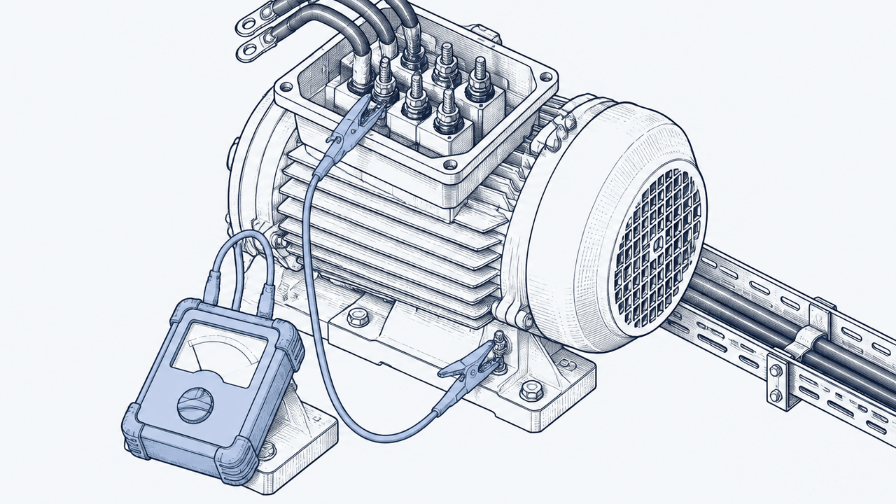
- Insulation-test the motor and cable together, with the drive disconnected. Never insulation-test the drive itself. Siemens says never to use high-voltage insulation test equipment on cables connected to the inverter (Operating Instructions p. 26). ABB says not to do voltage withstand or insulation tests on any part of the drive, because it can damage it. For the motor and cable, ABB says to disconnect the cable at the drive's output and measure each phase conductor to PE at 1000 V DC (Hardware manual p. 114). Yaskawa's oC and GF lists ask you to check motor insulation and the resistance between the motor cables and the ground terminal (Technical Manual pp. 310–311). Expect: a reading above the motor maker's figure. ABB gives above 100 MΩ at 25 °C for its own motors, and for other motors says to follow that maker's instructions. Moisture lowers the reading; ABB says to dry the motor and measure again (p. 114). If low: go to step 6.
- Split the cable from the motor at the terminal box. Lift the cable lugs in the motor terminal box and test the cable and the motor windings separately. That tells you which one to replace. If, as in the 45 kW case, the leads go straight into the motor without a terminal box, you can't split them at the motor. Lifting the cable at both ends and testing it on its own still tells you about the cable. This step is our method, not a manual instruction.
- Check what's in the motor cable. ABB says there must be no contactors opening and closing in the motor cable, and no power factor correction capacitors or surge absorbers (Firmware manual p. 554). Yaskawa lists an output contactor switching while the drive is running as an oC cause (Technical Manual p. 311). Check cable length against the manual too: the MM440 runs at full specification with up to 50 m of screened or 100 m of unscreened cable (Operating Instructions p. 26). On the A1000, high output leakage current can cause GF; Yaskawa suggests reducing the carrier frequency and stray capacitance (p. 310).
- Check the settings. Is the motor data the same as the rating plate (ABB group 99, Firmware manual p. 554; MM440 motor power against inverter power, Operating Instructions p. 82)? Are ramp times long enough for the inertia? For oC, Yaskawa says to increase the acceleration time (C1-01, -03, -05, -07) and the S-curve settings (C2-01 to C2-04). Check boost and torque compensation too: Siemens says to reduce boost, and Yaskawa lists excessive torque compensation (C4-01) and V/f settings (E1-04 to E1-10). If the drive is started while the motor is still coasting, Yaskawa points to speed search, b3-01 (Technical Manual p. 311).
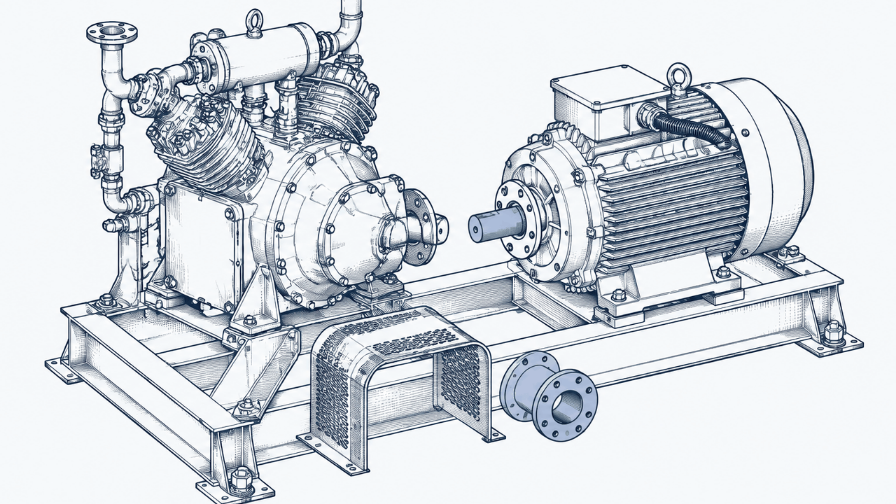
- Uncouple the load and run the motor on its own. Yaskawa's no-load test run is done with the motor uncoupled from the load. The motor should turn and accelerate and decelerate smoothly (Technical Manual p. 121). Expect: a clean run through the same speed range that tripped. If it runs clean uncoupled but trips coupled: look at the machine. Siemens lists an obstructed or overloaded motor (Operating Instructions p. 82). Yaskawa says to measure motor current and look for sudden fluctuations (Technical Manual p. 311).
What does the manual say vs what has fixed it in the field?
| Manuals | Field reports | |
|---|---|---|
| Drive | MM440: fault with all external cables disconnected except the supply means the drive is very probably defective (Parameter List p. 309) | 45 kW MM440 on a compressor (Siemens forum, 2021): F0001 with the motor disconnected, motor insulation above 200 MΩ phase to earth, still F0001 in the workshop with all controls disconnected. The owner concluded it was the drive. No confirmed fix posted. MM440 (Siemens forum, 2013): a later post in the thread reports F0001 with the motor disconnected, coming on at power-up once the DC link had charged. The fix reported in that thread, reseating the CPU card connectors, is covered in our MM440 F0001 post. Single report |
| Cable vs motor | Measure motor and cable insulation, phase to PE, with the drive disconnected (ABB HW p. 114) | Old VMC spindle drive, a CNC spindle drive rather than a general-purpose VFD (Practical Machinist, 2018): Garwood "meggered the motor and thought it was bad", replaced it, and still had problems. Then he "disconnected the motor wires at both ends and meggered them to find they were shorted in the cableway". He'd lost a couple of spindle drives before that. Single report |
| Load and settings | Load, ramps, motor data, boost, contactors and capacitors in the motor cable (MM440 OPI p. 82; ABB FW p. 554; Yaskawa TM p. 311) | No field reports found yet |
| Confidence | Official | Single reports. The Siemens forum threads were read through search-engine copies because the forum blocked direct access; see Sources |
The cable-vs-motor report is the expensive lesson. The motor test pointed at the motor, and a new motor didn't fix it. Disconnecting the cable at both ends and testing it on its own found the fault. Testing the cable separately first would have pointed there before a new motor was bought.
Fault-code entry (summary)
| Field | Value |
|---|---|
| Code | Overcurrent: Siemens MM440 F0001 · ABB ACS580 2310 · Yaskawa A1000 oC |
| Related codes | MM440 F0022 (hardware monitoring, includes IGBT short and, on some sizes, ground fault) · ACS580 2330 (earth leakage), A2B1 (overcurrent warning), A2B4 (short circuit warning), 2381 (IGBT overload, can be caused by a motor cable short) · A1000 GF (ground fault) |
| Suspects | Drive output stage · motor cable · motor winding or insulation · load and settings |
| Checks in order | 1. Record trip point and stored data · 2. ABB aux code phase · 3. Permanent or sporadic · 4. Drive alone, motor cable off · 5. Insulation test of cable + motor, drive disconnected · 6. Split at terminal box · 7. Contactors, capacitors, cable length · 8. Motor data, ramps, boost · 9. Uncoupled run |
| Never | Insulation-test or high-voltage test the drive, or cables still connected to it |
| Field fixes reported | Drive defective with motor disconnected (unconfirmed, single report). Cable shorted in the cableway after the motor had been replaced (single report) |
| Manual reference | MM440 OPI pp. 26, 82; MM440 Parameter List p. 309; ACS580 FW pp. 538–541, 554–555; ACS580-01 HW p. 114; A1000 TM pp. 121, 310–311, 334 |
| Last verified | 25 Oct 2026 |
Why write down which suspect you ruled out?
Because the next person to see this trip will start the list again from the top. If the job card says "drive tested alone, OK; cable and motor 1000 V to PE, values per phase; motor uncoupled, ran clean", they can skip four steps. If it says "reset, running", they can't. The same goes for the cable fault above. A note that the motor had been replaced, and the fault came back, would have sent the next engineer straight to the cable. More on that in "it's running now" is not a fix.
How would you find this in your own archive?
If this drive has tripped before, the insulation readings and what was replaced may already be in a service report that says "overcurrent", "megger", "earth fault" or just the fault code. HangerSearch searches your own finalized service reports by fault code, machine or symptom. It shows the prior cases that match and why, and opens the cited page. Nothing is generated. See how that works for a repeat machine fault, and how we handle your reports.
Book a 20-minute demo: hangersearch.com
FAQ
How do I tell whether an overcurrent trip is the drive or the motor?
Isolate, wait out the discharge time, then disconnect the motor cable at the drive's output terminals and power the drive up. Siemens's MM440 guidance says that if the fault still occurs with every external cable disconnected except the supply, the drive is very probably defective. If it doesn't, the drive is less likely and the cable, motor and load are next.
Can I megger the motor with the drive still connected?
No. Siemens says never to use high-voltage insulation test equipment on cables connected to the MM440. ABB says not to insulation-test any part of the ACS580, because it can damage the drive. Disconnect the motor cable at the drive output first. Then test each phase conductor to PE. ABB specifies 1000 V DC for this.
What insulation reading is good enough for the motor and cable?
Use the motor maker's figure. ABB gives above 100 MΩ at 25 °C as a reference for its own motors and says to follow the manufacturer's instructions for others. Moisture lowers the reading, so ABB says to dry the motor and measure again before condemning it.
Why does the drive trip on overcurrent only when it accelerates?
The current needed to accelerate depends on the ramp time and the load's inertia. All three manuals list acceleration time as a check. Siemens and Yaskawa also list boost or torque compensation. If the motor runs through the same ramp cleanly when uncoupled from the load, look at the machine side: an obstruction, a heavy or changing load, or a ramp too short for the inertia.
Does an earth fault show up as an overcurrent trip?
It can. ABB says 2310 can be caused by an earth fault, and the ACS580 also has a separate earth leakage fault, 2330. Siemens says the MM440 trips on F0001 if an output phase shorts to ground on an ungrounded supply, and lists earth faults among F0001's causes. The A1000 has its own GF fault.
Sources
- Siemens, MICROMASTER 440 Operating Instructions (0.12 kW–75 kW), 6SE6400-5AC00-0BP0, Issue 12/01. Read as a PDF on 25 Oct 2026. Supports: the warning never to use high-voltage insulation test equipment on cables connected to the inverter, the 5-minute discharge wait, F0001 on an output phase short to ground on ungrounded supplies, and full specification with up to 50 m screened or 100 m unscreened cable (p. 26); the F0001 causes and checks, including boost and ramp time (p. 82). Printed page numbers. Paraphrased.
- Siemens, MICROMASTER 440 Parameter List, 6SE6400-5BB00-0BP0, Issue 01/06. Read as a PDF on 22 and 25 Oct 2026. Supports: F0022 causes, the permanent vs sporadic split, the disconnect-the-motor-cable and all-cables-off guidance, and the sporadic causes (p. 309); F0001 (p. 307). Printed page numbers. Paraphrased.
- ABB, ACS580 standard control program Firmware manual, 3AXD50000016097 Rev J (effective 1 Oct 2025). Read as a PDF on 25 Oct 2026. Supports: event log, 32 faults and 32 warnings, nine stored parameter values, 05.80–05.88 (pp. 538–539); A2B1 and A2B4 (pp. 540–541); 2310 cause, auxiliary code and checks (p. 554); 2330 and 2381 (p. 555). Printed page numbers. Paraphrased.
- ABB, ACS580-01 drives Hardware manual, 3AXD50000044794 Rev D. Read as a PDF from a distributor copy (purvisindustries.com) on 25 Oct 2026. Supports: no insulation tests on the drive; motor and cable test with the cable disconnected at the drive, each phase to PE at 1000 V DC; the 100 MΩ reference for ABB motors at 25 °C; moisture and drying (section "Measuring the insulation", p. 114). Paraphrased.
- Yaskawa, AC Drive A1000 Technical Manual, SIEP C710616 27C. Read as a PDF on 25 Oct 2026. Supports: no-load test run with the motor uncoupled (§4.8, p. 121); GF causes and solutions (p. 310); oC causes and solutions (p. 311); U2 fault trace monitors (§6.9, p. 334). Paraphrased.
- Siemens Industry Online Support forum, "Micromaster 440 tripped on overcurrent F0001 and can not be reset.", started by JS1892, 29 Sep 2021, reply from wmartin987: https://support.industry.siemens.com/forum/WW/en/posts/micromaster-440-tripped-on-overcurrent-f0001-and-can-not-be-reset/269242. Supports: the 45 kW compressor case, the tests done, the quotes, and the replies. No confirmed fix. Read through a search-engine copy on 25 Oct 2026; the forum returned Access Denied to direct requests.
- Siemens Industry Online Support forum, "F0001 CONTINUOSLY COMES ON MM440 DRIVE", started 18 Mar 2013: https://support.industry.siemens.com/forum/gb/en/posts/f0001-continuosly-comes-on-mm440-drive/89116. Supports: the later post reporting F0001 with the motor disconnected after DC link charge. Read through a search-engine copy; paraphrased.
- Practical Machinist, "Fanuc 10t SV013???", reply #5 from Garwood, 8 Apr 2018: https://www.practicalmachinist.com/forum/threads/fanuc-10t-sv013.348945/. Supports: the motor-replaced-then-cable-found report and quotes. Read 25 Oct 2026. Single report.