
Article
Service engineer job card format (with a filled example)
A customer asking for the report of every service visit is asking for job cards. This post lists the fields a service engineer's job card needs in India (serial, fault code, cause, parts, status, sign-off), how it feeds the AMC report, and an invented filled example.
On 15 July 2026, Paresh Kumar Das (@PareshKuma8bwy) posted a two-part message on X to an electronics retailer's customer-care team about his air conditioner: "I did not ask for another inspection or repair. I requested the complete records of all inspections and rechecks carried out on my AC." He then listed what he wanted: "The date of every inspection and recheck", "The name of every technician/engineer who visited.", "The complete inspection/service report for each visit." and "The details of all checks, observations, and findings made during every visit."
That list is, almost line for line, a job card. Date, engineer, what was checked, what was observed, what was found, one record per visit. When those records exist and are signed, the next visit, the AMC report and any dispute start from them. When they don't, nobody can reconstruct what happened.
Short answer: A service engineer job card is the one-visit record the engineer fills on site and the customer signs. A usable format has fixed fields: job card and complaint number, visit number, date and time in/out, call type, AMC or warranty reference, customer and site, machine make, model and serial, fault code as displayed, complaint, checks and readings, cause found, action taken, parts with part numbers, parts pending, status at departure, and both signatures, or the reason the customer did not sign.
Applies to: service engineers of Indian machine builders, OEMs, dealers and AMC contractors who attend breakdowns, preventive (PPM) visits and installations at customer sites, and the service coordinators who file the job cards afterwards. Dates use DD/MM/YYYY. Last verified: 10 Nov 2026. Author: Muhammed Fahiz
The job card is the field record. Our AMC service report format post covers the finalized visit report built from it, and the US version of that report is the field service report template.
What is a service engineer job card?
A job card is the record of one visit, written at the machine while the engineer is still there. Zentid's template page defines it as "the record of one job, from the problem reported to the customer's sign-off." Safee's job sheet template page says the same thing in different words: "A field service job sheet, also called a service report or job card, is the record of one visit by a technician to a customer site."
Three documents get mixed up here, and the names vary by company. Zentid's page separates them by when each one is written:
| Document | When it is written | What it answers |
|---|---|---|
| Work order / service call | Before the visit | What to do, where, when, what to bring |
| Job card | During the visit, on site | What was found and done, parts and time used, signed by the customer |
| Service report / AMC report | After the visit | Findings, recommendations and equipment status, filed against the contract |
Adapted from Zentid's "Job card, work order or service report?" table.
Zentid's FAQ puts the first split plainly: "A work order tells the technician what to do before the job. The job card records what was actually done during it."
The second split matters more here. The AMC service report is usually typed later from whatever the job card says. If the card says "checked, OK", so does the report, and so does the machine's history.
What should a service engineer job card include?
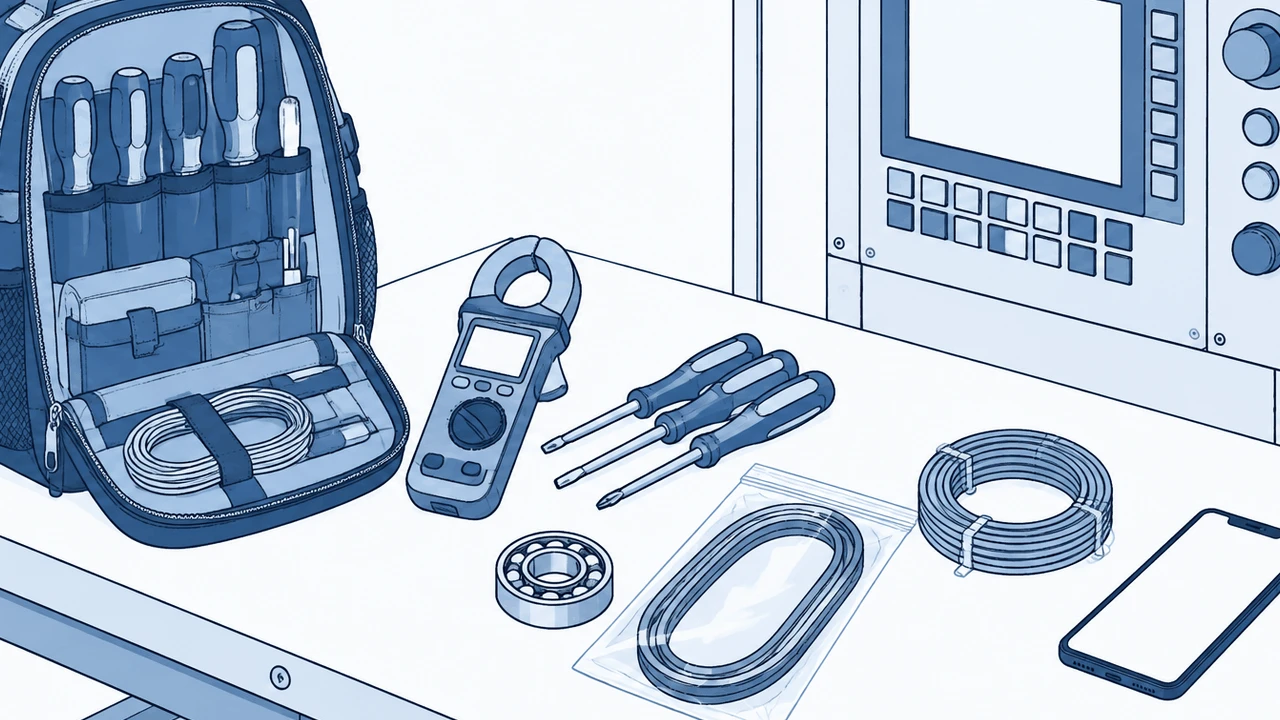
The public formats we read agree on a core set. Zentid lists job card number, date and a reference (PO, AMC or quote number); customer, site and contact; time in and out; equipment make, model and serial; job type ("breakdown, PPM, installation, AMC visit, inspection or other"); billing basis ("chargeable, warranty or AMC"); reported problem and work carried out; parts and labour; job status; and both signatures. Safee's sheet adds a visit number, fault and cause as separate lines, parts "with their source", "the reason if not completed", a follow-up visit and safety checks before work (permit to work, PPE, isolation).
An Indian manufacturer's own form shows the same logic. The installation report of Iatome Electric India, a Coimbatore equipment maker, says: "This report is to be filled in by the Service Engineer carrying out the installation", and "One copy of this report shall be handed over and retained by the customer". It records the serial both as filled in at the factory and as the "SERIAL NUMBER PRINTED ON UNIT", and its footer reads: "This Document is Valid Only if Customer Signature is present". It is an installation form, not a repair card, but the pattern holds: the engineer fills it, the customer signs it, both keep a copy.
Most of those fields exist for billing and proof of attendance. A job card can pass both tests and still be useless to the next engineer.
Service engineer job card format: which fields make it useful after the visit?
Each field below has a job after the engineer leaves: it ties the card to a contract and a complaint, finds the machine again, or tells the next engineer what was actually done.
| Field | What goes in it | Why it matters after the visit |
|---|---|---|
| Job card no. | Unique number, printed or system-generated, never reused | The AMC report and the invoice can cite one visit without confusion |
| Complaint / call no. | The number the customer was given when they called | Matches the customer's follow-up call to the visit |
| Visit no. | 1, 2, 3... for the same complaint | A second visit gets its own card instead of hiding inside the first |
| Date (DD/MM/YYYY), time in, time out | Written on site as it happens | Keeps the machine's history in true order |
| Call type | Breakdown, PPM, AMC visit, installation, warranty, inspection | Separates planned visits from breakdowns in a filter |
| Cover and contract ref. | AMC no., warranty, or chargeable | Puts the visit under the right contract and billing basis |
| Customer, site, contact | Company, plant, person met | Finds the site when the tag is missing |
| Machine and location | Plant asset tag, plus line, bay or shop | Groups every visit to one machine |
| Make and model | As on the nameplate | Lets you search across identical machines at other customers |
| Serial no. | As printed on the unit | Tells two identical machines apart |
| Running hours / counter | Hour meter or cycle counter, if the machine has one | Gives the next visit a baseline for wear and service intervals |
| Fault code / alarm as displayed | Exact code and text on the HMI, controller or drive, or "none" | The most precise search term the card will ever hold |
| Complaint (customer's words) | What the operator or supervisor said was wrong | Matches the next complaint, which will use the same words |
| Checks and readings | One line per check, with the value | Shows what was ruled out |
| Cause found | What the checks showed, not a guess; "not found" is allowed | The field that turns a visit into a fix someone can reuse |
| Action taken | What was actually done, in plain words | Tells the next engineer whether to repeat a step or skip it |
| Parts replaced | Part name, part no., qty, source (engineer stock or customer store) | Search by part; keeps spares and invoices right |
| Parts pending / follow-up | Part on order, return visit needed, quotation required | Turns an open item into a next job instead of a surprise |
| Status at departure | Working, working with limits, down (and why) | Tells the next visit what state the machine should be in |
| Engineer name and signature | Name, signature, date | Accountability for what the card says |
| Customer name, designation, signature, seal | Or the reason it was not signed | Confirms the visit; a missing signature has a recorded reason |
Our recommended fields, not a published standard. Zentid, Safee and Iatome list overlapping fields; the visit number follows Safee's rule for second visits, and the search fields match our AMC service report format.
Four fields do most of the work later: serial number, fault code exactly as displayed, cause found and part number. Everything else proves the visit happened and gets it billed.
To use the format, copy the header row below into a sheet, or use the same order for the boxes of a printed carbon-copy card, and keep it fixed:
Job card no. | Complaint no. | Visit no. | Date | Time in | Time out | Call type | Cover / contract ref. | Customer | Site | Contact | Machine / location | Make | Model | Serial no. | Running hours | Fault code as displayed | Complaint | Checks and readings | Cause found | Action taken | Parts replaced (part no., qty, source) | Parts pending / follow-up | Status at departure | Engineer | Customer name / designation | Signed? (if not, why)
How does the job card feed the AMC service report?
The job card is the source; the AMC service report is the copy that gets filed. Each visit produces one job card at the site, and someone later enters that visit into the AMC report. Our AMC service report format starts with a "Report / job no." column for this reason: it ties the finalized report back to the field job card. Four rules follow:
- One card per visit. A breakdown that needs a part and a second visit gets two cards with the same complaint number and visit numbers 1 and 2. Safee's template is explicit: "A second visit to the same job gets a new sheet and a new row with visit number 2, so first-time fix stays accurate." Its common-mistakes list names the opposite as an error: "One sheet for several visits. A second visit hides inside the first, and first-time fix looks better than it is."
- Copy fields one to one. The AMC report should carry the same serial, fault code, cause, action and part number as the card. Rewritten in the office, the wording drifts and a later search misses it.
- Write the job card number on the report, so each can be traced to the other.
- Keep the signed card. Scan it and file it with the report. The report is what you search; the signed card is what you show when a visit is questioned.
If the plant keeps a breakdown register, the OEM's job card number belongs in that row too.
What does a filled job card look like?
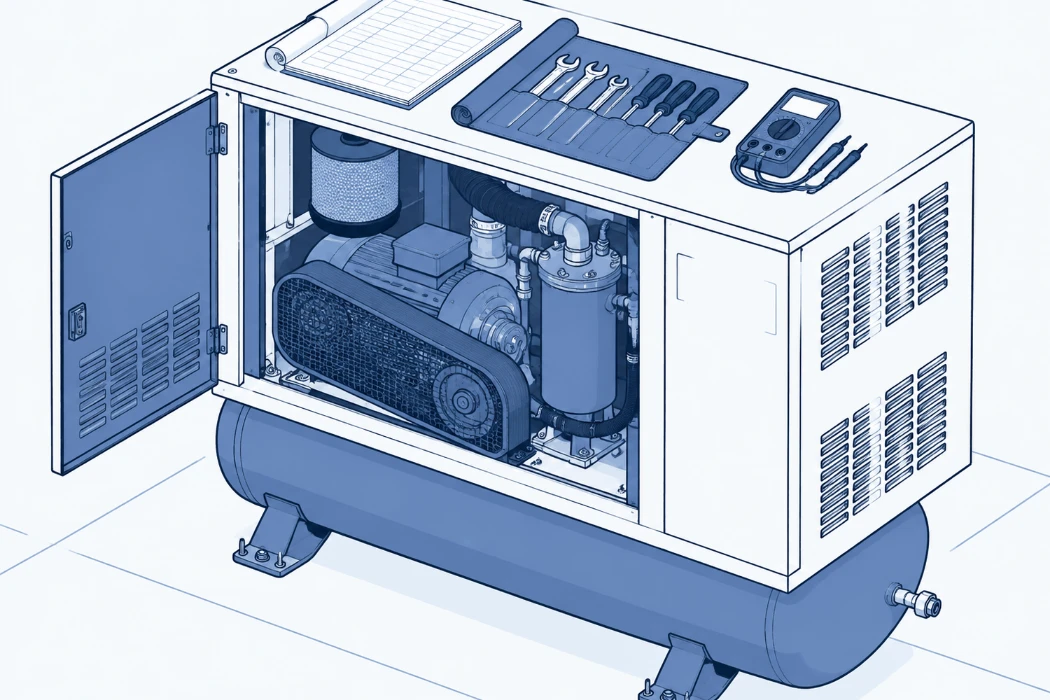
The job card below is an illustrative example invented for this template. The company, machine, serial, alarm text, readings and part numbers are made up: not a real customer record, not a fault-code reference, not a specification for any machine.
| Field | Entry (invented example) |
|---|---|
| Job card no. | JC-2025-0418 |
| Complaint no. / visit no. | CMP-7731 / visit 1 |
| Date, time in, time out | 12/03/2025, 10:40, 13:15 |
| Call type | Breakdown |
| Cover and contract ref. | AMC, AMC-2025-017 |
| Customer, site, contact | Example Auto Components Pvt Ltd, Plant 2, Maintenance in-charge |
| Machine and location | COMP-02, compressor room |
| Make and model | Oil-injected screw air compressor, 37 kW (as on nameplate) |
| Serial no. | SC37-25-00912 |
| Running hours | 18,420 h |
| Fault code / alarm as displayed | "HIGH DISCHARGE TEMP" trip (example text) |
| Complaint | Compressor trips after about 40 minutes of running, mostly in the afternoon |
| Checks and readings | Discharge temp at trip: 109 deg C (example); oil level OK; cooler fins choked with dust; cooling fan running |
| Cause found | Oil cooler fins choked; thermostatic valve slow to open on test |
| Action taken | Cleaned oil cooler with air and brush; reset; ran 60 min under load, no trip |
| Parts replaced | None |
| Parts pending / follow-up | Thermostatic valve element TV-37-EX (1), on order; visit 2 to fit |
| Status at departure | Working with limits (keep compressor room doors open until visit 2) |
| Engineer | S. Kumar, signed |
| Customer name / designation / signature | R. Nair, Maintenance Engineer, signed with seal |
Illustrative example only. Invented for the template. Not a real customer record or field report.
The same machine (COMP-02, serial SC37-25-00912) across three cards, as rows in a log:
| Date | Job card no. | Complaint / visit | Call type | Fault code as displayed | Cause found | Action taken | Parts | Status | Signed? |
|---|---|---|---|---|---|---|---|---|---|
| 12/03/2025 | JC-2025-0418 | CMP-7731 / 1 | Breakdown | HIGH DISCHARGE TEMP | Cooler choked; valve slow | Cleaned cooler; test run | TV-37-EX pending | Working with limits | Yes |
| 15/03/2025 | JC-2025-0431 | CMP-7731 / 2 | Breakdown | - | Valve slow (visit 1) | Fitted valve element; test run | TV-37-EX (1) | Working | Yes |
| 10/06/2025 | JC-2025-0702 | - / 1 | PPM | - | - | Changed oil and air filters | Oil filter, air filter | Working | No: in-charge on leave; supervisor informed |
Illustrative examples only. Invented for the template. Not real customer records.
Filter by serial and the March breakdown reads as one complaint with two visits, linked by CMP-7731, with the part that closed it. Search "HIGH DISCHARGE TEMP" and the cause comes up. The June card was not signed, and the reason is on the card. A card that said only "Compressor checked, working" would answer none of those searches.
Why does the customer signature matter, and what if they won't sign?
The customer's signature is what turns the engineer's notes into a record both sides accept. Safee's page puts it in billing terms: "The sheet is the basis for the invoice and for any dispute about the visit", and among its common mistakes, "No customer signature. An unsigned sheet is weak support for an invoice." Iatome's installation form goes further and states that the document is valid only if the customer's signature is present.
A signature box alone does not settle anything, though. On 5 November 2026 a customer posting as Mahendrasinh (@Mahendrasinh302) wrote on X that a job sheet for his geyser complaint said "Visit Complete - No Issues", while, in his words, "no technician visited my home." He added: "It also shows 'Customer signature not available'." That is one side of one dispute, and we do not know what happened. But it shows a job sheet with a status and a signature line and nothing in between: no checks, readings or cause that would show a visit took place.
Two rules follow. Get the signature on site: Safee's procedure is that the customer signs "before the technician leaves. If they refuse or are not there, the technician writes why." And make the body of the card carry the proof: times, readings, cause found and a photo of the nameplate or replaced part. A signature confirms the card; the fields make it worth confirming.
What goes wrong with paper job cards?
FactoStack, an Indian manufacturing-software vendor that sells an "AMC & Job Card Tracking" module, describes the most basic failure on its Field Services page: "Engineers carry physical job cards that get lost, damaged, or never make it back to the office." The same page lists "Parts used on-site are not recorded" as a separate gap. That is a vendor's framing of the problem its product addresses, not a survey.
Safee's common-mistakes list adds "Writing times at the end of the day", "'Not completed' with no reason" and "Parts written as 'various'". Two more are specific to how job cards feed machine history:
- Fault code paraphrased. "Temp trip" on one card and "HIGH DISCHARGE TEMP" on the next will never come up in the same search. Write the code as displayed.
- Cause left blank on a successful visit. "Working" at departure is the status, not the cause. If the machine runs after a reset, write what was checked and that the cause was not found. See why "it's running now" is not a fix.
Carbon-copy pad, spreadsheet typed from cards or phone app: any of them works if the fields are fixed, cause, fault code and part number cannot be skipped, and the card reaches the file. The test: can an engineer who has never been to this site find the last visit to this machine by serial, fault code or part number in a few minutes?
What this doesn't tell you
Both X posts are from consumers in India about home appliances, not industrial service visits, and each is one person's public account. We do not know the cause or outcome of either case and make no finding about any company. Zentid, Safee and FactoStack are vendor pages, cited for their field lists and wording, not as standards or endorsements; Zentid and Safee are not India-specific. Iatome's form is an installation report, not a repair job card. The field list and examples are ours, and the examples are invented. We found no study that measures how much a fixed-field job card reduces repeat visits.
Where does HangerSearch fit?
If your engineers already write job cards and AMC reports, the next problem is finding the right earlier visit when the same machine is down again. HangerSearch is private, retrieval-only search over your team's own finished service reports, searched where they already sit. You search by fault code, model or symptom. It shows the earlier reports that match and why each one matched, and opens the cited page. Nothing is generated, and if there is no similar report, it says so. It cannot invent a cause or a part number that was never written on the card, which is why the job card fields come first. See how we handle your reports.
Book a 20-minute demo: hangersearch.com
FAQ
What is a service engineer job card?
The record of one service visit, filled by the engineer at the site and signed by the customer: which machine, the complaint, what was checked, found and done, parts used, the state the machine was left in, and who signed. The AMC or service report is built from it later, so put the job card number on the report.
What fields should a job card format have?
Job card and complaint number, visit number, date and time in/out, call type, AMC or warranty reference, customer and site, machine make, model and serial, fault code as displayed, complaint, checks and readings, cause found, action taken, parts with part numbers, parts pending, status at departure, and engineer and customer signatures.
What if the customer refuses or is not available to sign the job card?
Write the reason on the card before you leave, with the name of the person you informed, as Safee's template procedure says. Make sure the card body carries times, readings and cause, so the record stands on its own.
Should a second visit for the same complaint use the same job card?
No. Give it a new card with the same complaint number and visit number 2, so each visit's time, findings and parts stay separate and you can count how many visits a complaint took.
Sources
- Paresh Kumar Das (@PareshKuma8bwy), public two-part post on X to a retailer's customer-care team, 15 Jul 2026: https://x.com/PareshKuma8bwy/status/2077422085891338682 and https://x.com/PareshKuma8bwy/status/2077422090152714740. Opened via the X API, 10 Nov 2026. Supports: the opening quotes, as written. Outcome unknown.
- Mahendrasinh (@Mahendrasinh302), public post on X, 5 Nov 2026: https://x.com/Mahendrasinh302/status/2118234625420194132. Opened via the X API, 10 Nov 2026. Supports: the quoted job sheet wording and the poster's statement. One side of one dispute.
- Zentid, "Job card format and template", https://zentid.com/templates/job-card-format/. Read 10 Nov 2026. Supports: definition, field list, work order / job card / service report table. Vendor page.
- Safee, "Field Service Job Sheet Template and Visit Log", https://safee.com/templates/field-service-job-sheet/. Read 10 Nov 2026. Supports: definition, second-visit rule, sign-off procedure, common mistakes. Vendor page.
- Iatome Electric India Pvt Ltd, "Installation Report" form (PDF), https://www.alerio.in/wp-content/uploads/2022/01/installation_report_format.pdf. Read 10 Nov 2026. Supports: engineer-filled form, customer copy, serial on unit, signature validity.
- FactoStack, "Field Service Management Software India - AMC & Job Card Tracking" (Field Services page; title separator shown as a hyphen), https://factostack.com/field-services. Read 10 Nov 2026. Supports: the category exists in India; the vendor's description of paper job cards. Vendor framing, not data.
Related
- AMC service report format, with the fields that make the next fix findable
- Field service report template built for the next technician
- Breakdown register format (Excel) that you can still search in two years
- Equipment repair log template that stays searchable
- Same machine, five descriptions: why repeat faults never add up
- Find a past service fix for a repeat machine fault
- How HangerSearch handles your data